Ham Radio · Antennas · Site Update · October 2026
Homebrew Antennas: A Hentenna Calculator, an Antenna Advisor and a Pattern Simulator
GazLabs has a new antennas section. It has a hub page for anyone wondering what to build, a hentenna calculator, calculators for a handful of other fun wire and tube antennas, and a tool that shows a predicted radiation pattern and tells you whether an antenna behaves as vertical or horizontal depending on how you mount it. It's all free and runs in your browser.
Quick take: Tell the advisor your band, your space and your supports, and it suggests what to build and how to put it up. Then use the calculators for cut lengths and the pattern simulator to see what you'll get.
What's in it
- Homebrew Antennas hub — a guide to home-built antennas, a table of designs with their size at your frequency, feed impedance and polarisation, and the advisor form.
- Hentenna calculator — dimensions and a tube cut list for any frequency.
- More antenna calculators — dipole, inverted-V, end-fed half-wave, full-wave loop, two-element quad, ground plane, J-pole and coax length.
- Antenna pattern simulator — predicted patterns and polarisation for each design.
The hentenna
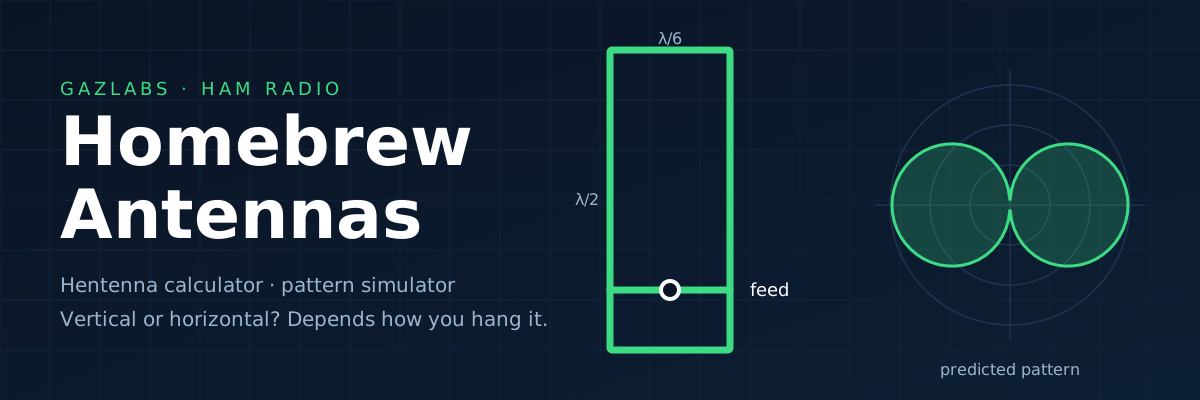
The hentenna is a tall, narrow rectangular loop with a horizontal bar across it, fed on that bar a little way up from the bottom. It's a Japanese design from the 1950s that's popular for 6m, 2m and 70cm because it's light, cheap and easy to make from wire, tube or even a bit of ladder line. Standing upright it's a horizontally polarised antenna with a broad, roughly figure-of-eight pattern. Turn it on its side and the polarisation flips to vertical.
| Dimension | Formula | Example at 145 MHz |
|---|---|---|
| Height | λ/2 × k | about 1.00 m |
| Width | λ/6 × k | about 0.33 m |
| Feed bar height from bottom | λ/10 × k | about 0.20 m |
Here k is a shortening factor. The calculator defaults to 0.97 for tube, and you can change it along with the conductor size, a fitting allowance and the feed gap. It gives you a cut list so you can go straight to the hacksaw. These are starting points: trim against an antenna analyser, because nearby objects and your exact build will move the resonance.
Vertical or horizontal?
The polarisation of an antenna follows the direction of the current in it, so it depends on how you mount it. A dipole strung level is horizontal and the same dipole hung vertically is vertical. Loops and quads depend on where you feed them. The hub page and every calculator state the polarisation of each design, and give advice for compromise installs when you can't put it up the ideal way.
| Mounting | Polarisation |
|---|---|
| Hentenna upright | Horizontal |
| Hentenna on its side | Vertical |
| Hentenna at 45° | Mixed |
A slanted 45° antenna loses roughly 3 dB against either pure polarisation, but it hears both, which is a reasonable compromise if you want to work a mix of FM repeaters and SSB. A full mismatch (vertical to horizontal) can cost up to about 20 dB on a line-of-sight path, so it's worth getting right for the signals you care about.
The antenna advisor
The form on the hub page asks for your frequency or band, the space and supports you have, how high you can go, and what you want to do. It then suggests what to build, how to install it, and what polarisation you'll get. The recommendation links to the matching calculator, and your frequency is carried across so you don't have to type it in again.
The pattern simulator
The simulator solves the antenna's currents with a method-of-moments model, which is the same kind of calculation used by NEC-based antenna programs, and shows the predicted pattern. You choose the antenna, frequency, mounting height, tilt, feed position and ground type, and it reports the gain and whether the main lobe is mostly vertically or horizontally polarised. It also compares orientations side by side and gives you a share link for your settings.
It's a prediction, not a measurement. The model is approximate, and real buildings, trees, feedlines and nearby metalwork will change what you get. For example, the simulated hentenna gain is about 5 dBi, which is a little below the figure often quoted for the design. Use it to compare designs and orientations and to understand why one behaves the way it does, then confirm with your analyser and on-air reports.
Try it
Start at the Homebrew Antennas hub, or jump straight to the hentenna calculator. If you build one, let me know how it goes.
All the calculators are guides only. Always check the match with an antenna analyser before you transmit, and take care putting up antennas near power lines.